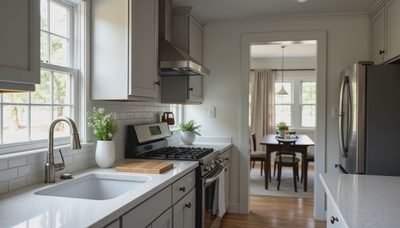
Every week, I stand in a Charlotte seller's kitchen and answer the same question: is a kitchen remodel before selling house worth the money, or am I about to watch someone spend the profit from the sale on a room the buyer will redo anyway? After eight years running renovation projects across the area — coordinating crews, reviewing bids, and scoping scopes of work — and more years since advising sellers on pre-sale work, I've landed on a shorter answer than most contractors will give you. It starts with the cabinet boxes.
The cabinets are the largest single surface in the room. They decide whether the kitchen reads fresh or dated before the buyer looks at anything else. And here is what the resale math keeps telling me: the gap between "fresh" and "dated" in a buyer's eye is rarely a new kitchen. It's the doors, the finish, and the hardware.
So the real question is not what you'd like to cook in. It's what pushes the offer up in the strongest weeks of the Charlotte spring market — and what sits there quietly, costing you money without moving the price. Let me walk you through the three paths I actually recommend, with the cost ranges I see on real bids around this area.
The Three Paths, and What Each Costs
When a kitchen remodel before selling house is on your to-do list, you have three paths in front of you: full replacement, refacing, and professional paint. The price spread between them is wide, and most sellers can narrow the choice down in a single conversation once they know what each path fixes — and what it doesn't. The mistake I see most often is paying for one path's cost while expecting another path's result.
Full Replacement: Stock, RTA, Semi-Custom, and Custom
Full replacement means new boxes, new doors, new drawer fronts — the whole system comes out and goes back in. There are three tiers, and sellers routinely assume they need a tier higher than they do.
Stock and RTA cabinets (ready-to-assemble, shipped flat and assembled on site): for a standard 10×10 kitchen, roughly 20 linear feet of cabinetry, I see installed bids in the 12,000 range before hardware upgrades.
Semi-custom: 20,000 for the same footprint once you start choosing door styles, wood species, and finish options from a manufacturer's line.
Custom-built: typically 30,000 to $40,000 is a normal conversation.
The honest note: unless the kitchen is being reconfigured — sink relocated, island added, layout changed — the stock and RTA tier is where pre-sale money should sit. A buyer walking a $450,000 listing cannot tell a well-built RTA cabinet from a custom one at a glance. They can tell the difference in your asking price.
Refacing: New Doors, Same Boxes
Refacing replaces the doors, drawer fronts, and exposed veneer while keeping the boxes in place. On the same 10×10 kitchen, refacing typically lands at 9,000 — roughly half the cost of a full replacement, sometimes a little under. It runs about a week of trade time, compared with two to four weeks for a full tear-out.
But refacing has limits I make sure sellers understand before they write the check:
The boxes must be structurally sound. Water damage near the sink, or hinge screws pulled loose from the face frame, means new doors are hanging on weak bones.
You cannot change the layout. No added island, no repositioned wall oven, no bigger pantry.
Drawer boxes usually stay original, so cheap particleboard drawers stay cheap.
Refacing earns its money when the doors are the problem and the layout is fine. When the layout is also a problem, you are spending refacing money on a kitchen the buyer will still read as the same kitchen.
Paint: The Low-Cost Route That Gets Undersold
Cabinet painting is the lowest-cost path, and it's the one sellers botch most often. A professional job — proper degreasing, sanding, primer, and a sprayed finish — runs 5,000 for a standard kitchen depending on door count and finish. Done right, it's the single highest-value move you can make before a listing.
Done wrong, it's a deduction. The giveaway is always the same: brush strokes and roller texture on the doors, visible at eye level from the entry. A buyer doesn't say "nice paint job." They say nothing, and the offer comes in lower because the finish reads as hurried. If you paint the doors yourself with a brush, you're gambling the whole kitchen on your ability to lay down a factory-smooth finish — and most weekend painters lose that bet. Spraying is the standard for a reason. It needs space, masking, and equipment most homeowners don't have in a fifteen-foot garage.
Here's the same decision in a table I use with sellers:
Path | Typical Cost (10×10 Kitchen) | Timeline | When It Works |
|---|---|---|---|
Full replacement | 12,000 (stock/RTA); 20,000 (semi-custom); $20,000+ (custom) | 4–6 weeks | Layout changes, damaged boxes, bigger budget |
Refacing | 9,000 | About 1 week | Sound boxes, doors are the issue, layout stays |
Professional paint | 5,000 | 4–6 working days | Sound boxes, tight budget or timeline, neutral look |
How I Read a Cabinet Box in Two Minutes
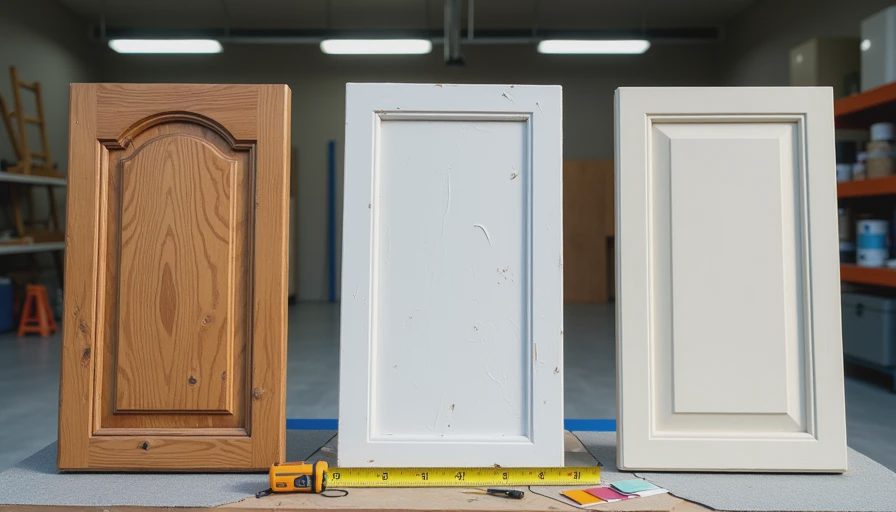
Before I recommend any of the three paths, I spend two minutes with the boxes themselves. The structure decides everything, and you can learn to read it faster than you'd think. Here's what I look at, in order:
Corners and seams at the sink. Water damage shows first at the joint under the sink base and along the seam where the counter meets the box. Swelling, darkening, or a soft spot means the box is compromised — and no amount of paint fixes rotten particleboard.
The hinges. Open every upper door and check the screw holes. If the screws spin free or the holes are patched and re-drilled, the doors have hung loose for years. That tells you the face frame is worn, and new doors won't seat right.
The drawer glides. A drawer that wiggles sideways when you open it is telling you about the box, not the door. Dovetail plywood boxes with soft-close glides justify a reface. Particleboard drawers with warped slides push me toward replacement.
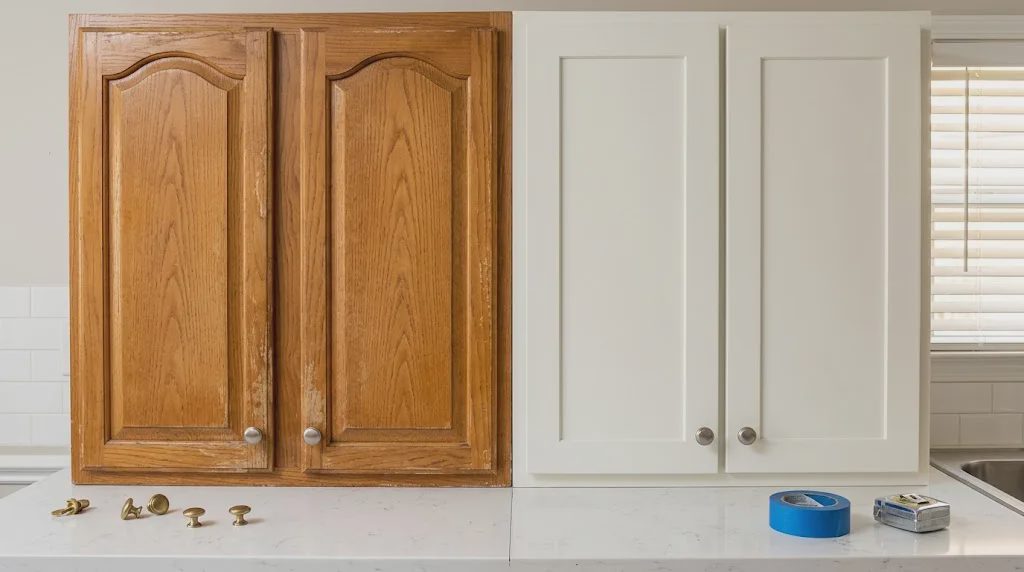
Door style and era. Raised-panel doors with heavy routed detail, arched uppers, or builder-grade honey oak say "2004" to a buyer the way a flat panel or shaker door says "current." Style obsolescence is a real cost — it's the main reason kitchens look dated even when everything works.
If this were my listing, here's where I'd spend first — and it's usually not on the boxes you can't see. It's on the doors and the finish, because that's the face the buyer stares at for the entire showing.
When the Boxes Force Your Hand
Some red flags make the decision for you. Water damage at the sink base, delamination on the side panels, a face frame pulling away from the box, or old leaks that were painted over instead of repaired — any of these means replacement, not refacing. I've watched sellers pay $6,000 for refacing over boxes that should have been replaced. The result is a kitchen that looks new and functions like a rental.
Time matters here too. Full replacement needs four to six weeks in Charlotte's scheduling climate: measure, order, build, install, and a counter-templating trip in the middle. Refacing runs about a week. Professional paint, with proper dry time between primer and topcoat, runs four to six working days. If your target listing date is thirty days out, that math decides for you.

Buyers See Visible Age Before Hidden Age
Here's the principle that organizes every pre-sale kitchen conversation I have: buyers buy what they can see, and they pay for what they can't. Visible age — chipped door edges, worn finish, dated hardware, mismatched pulls — gets priced in at the showing. Hidden age — old plumbing, aging appliances, an outdated panel — shows up later, in the inspection report and the credit request that follows it.
In the kitchen, the visible list is short: cabinet doors, hardware, countertops, and backsplash, roughly in that order. Cabinets dominate because they're the largest uninterrupted visual mass in the room. If the counters are in decent shape and the backsplash reads neutral, the doors and the finish are carrying most of the "fresh or dated" impression.
This is why I frame a kitchen remodel before selling house the way a contractor would: scope to the line of sight first, then spend the rest on the things that fail inspection. A 3,500 repair to a leaking disposal line changes what the inspector sees — which matters, but it doesn't move the first impression.
My Decision Framework for Pre-Sale Kitchens
After a few hundred walkthroughs, my cabinet framework has settled into three questions, in this order:
Are the boxes sound? No — replace, and stay in the stock or RTA tier unless the layout is changing. Yes — move to question two.
Are the doors the problem, or are they fine? If hinges are solid and frames are square, paint or refacing is a real option. If doors are warped or face frames are worn, new doors are needed.
What do your timeline and budget allow? Two weeks and 7,000 — reface. Six weeks and $12,000 — replace.
I call this value add remodeling before listing: every dollar either moves the offer or it doesn't, and the cabinets are where that logic shows up most clearly. The question isn't whether it's nicer. The question is whether it helps the sale. A neutral, clean, well-finished kitchen helps the sale. A showpiece kitchen that empties your budget and pushes the list price past the neighborhood ceiling does not.
The second caution is overspending into the wrong tier. When I review bids, I see sellers choosing custom cabinets because the kitchen is the heart of the home. That's a homeowner instinct, not a seller instinct. On a listing, the custom tier rarely returns its premium at resale. A stock or RTA tier, painted and finished well, returns a larger share of its cost — because it closes the gap between the kitchen and the price of the house.
If This Were My Listing Next Month
At the end of every walkthrough, I ask myself the same question: what would I fix if this were my own listing next month? For cabinets, my answer in most Charlotte homes is: paint the boxes in a soft neutral that works with the countertops, replace the hardware with satin brushed steel, and put the saved budget into the one or two things the inspector will flag — the faucet base, the disposal line, the GFCI at the sink.
My neighbors in the north Charlotte subdivision ask me about this constantly, and my wife Lauren keeps me honest on the home side. With Noah at eleven and Sophia at eight, our kitchen is where homework and breakfast collide, and the worn finish on our own doors tells me every day what a showing feels like. The counters and the sink area stay clean and current. The cabinets stay neutral. The offers do the rest. That split — spend where the eye lands, protect what the inspection checks — is value add remodeling before listing in practice.
The rule I give every seller who asks about a kitchen remodel before selling house is the same one I run on my own projections: spend where the buyer's eye lands first, protect where the inspection goes, and never let a renovation make your listing the most expensive house on the street. Don't renovate for applause. Renovate for the next offer.