
Every remodeling decision in a pre-sale house comes down to one question, and most sellers never ask it out loud: will this actually help the house sell better? Not "will this be nicer" — nicer is easy. Not "will this add value" — appraisers and buyers disagree on value all the time. The question that matters is narrower: does this work change the buyer's behavior, or just the buyer's opinion of your taste?
In eight years of residential project management in the Charlotte area, I've watched sellers pour money into projects that made the house objectively better and measurably harder to sell. A custom tile backsplash that took three weeks to install. A basement theater that narrowed the buyer pool. A landscaping redesign the neighborhood didn't ask for. None of those were bad decisions for a forever home. All of them were wrong for a listing. When sellers ask me should I renovate before selling my house, I give them the question first, not the answer.
The Test That Works on Every Project
Here's the test I run with every seller before any contractor is hired. Take the proposed project and answer three questions honestly:
Does this fix a problem a buyer would see or an inspector would find? Problems get priced. Improvements get admired but rarely priced.
Does this widen or narrow the buyer pool? The goal of pre-sale work is to appeal to the most buyers, not the ones who share your taste.
Would a buyer pay more for this specific change, or would they just say "that's nice"? Compliments don't sign offers.
If a project fails any of these three questions, it's not a pre-sale project. It might be a lovely thing to do to your house — but you're not renovating your house anymore. You're preparing a product for a market, and the market pays for problems solved, not taste validated.
Why "Nicer" Is the Wrong Goal
The single most expensive sentence in pre-sale work is "while we're at it, let's make it nicer." It sounds reasonable, it feels productive, and it's how a 28,000 kitchen remodel that pushes the listing by three weeks.
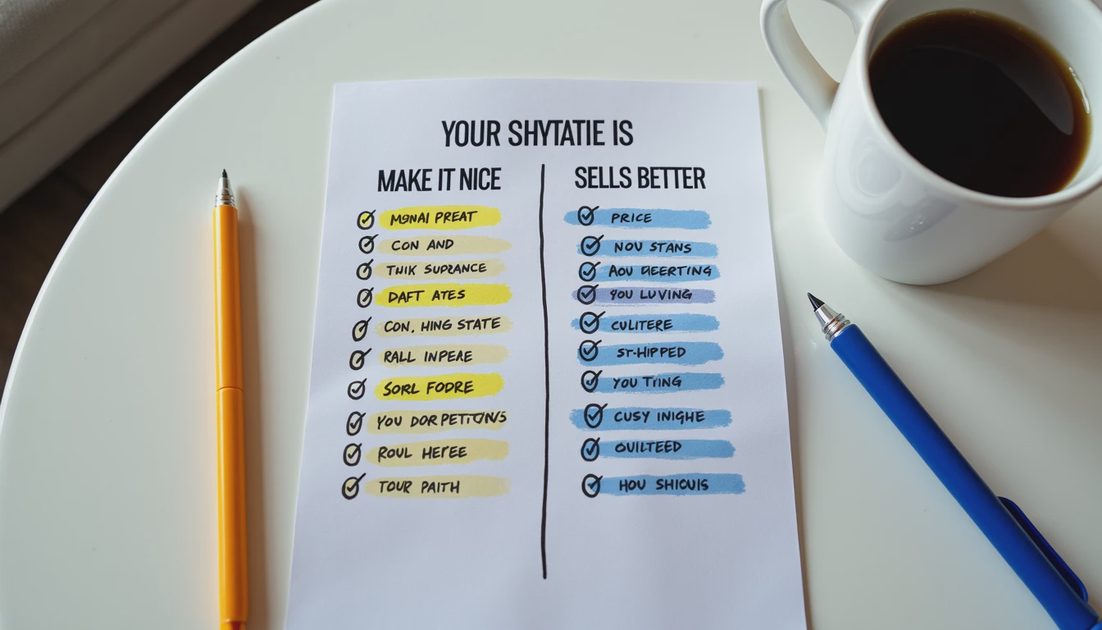
Here's the contrast that captures the difference between improving a house and helping it sell:
"Nicer" Project | "Sells Better" Project |
|---|---|
Custom tile backsplash with handmade look | Fresh neutral paint and clean grout |
Full kitchen remodel with new layout | Reface cabinets, new hardware, updated countertop |
Spa-style master bath with new tub | Regrout, new fixtures, clear glass shower door |
New hardwood throughout | Refinish existing hardwood, replace worn carpet |
Landscaping redesign with boulders and bed lines | Edge, mulch, trim, and clean the front walk |
Basement theater with seating and screen | Clean, deodorize, and stage the basement as finished space |
The left column makes the house nicer. The right column makes it show better, photograph better, and sell faster. Notice the pattern: the right column fixes visible problems and removes negative signals; the left column adds features buyers never asked for. When you're choosing how to spend a pre-sale budget, the right column wins every time — not because the left column is wrong, but because it answers the wrong question.
The Four Projects Worth the Money
If the question is "will this help the house sell better?" there are four categories of work that almost always pass the test. These are the projects I advise sellers to consider first, and they hold up across price ranges and neighborhoods:
Paint, in neutral tones. Paint is the cheapest way to change how a house feels, and it photographs better than any other finish. Neutral walls let buyers project their own furniture into the room.
Flooring that removes a negative. Damaged carpet, stained vinyl, and cupped hardwoods read as deferred maintenance. Replacing or refinishing them removes a complaint.
The exterior pass. The front door, siding repair, gutters, landscaping edges — the systems and surfaces a buyer sees before they step inside.
Kitchen and bath refreshes, not remodels. New hardware, refaced cabinets, updated fixtures, fresh caulk and grout. Scope control is the point.
Each of these passes the three-question test: they fix visible problems, they widen the buyer pool, and buyers actually pay for them. They're also the projects with the tightest schedules, which matters when the listing date is fixed.
The Projects That Fail the Test
For balance, here are the projects that routinely fail the test, even though homeowners love them:
A pool or hot tub. A pool narrows the buyer pool, adds liability, and delays the sale for many buyers with young kids.
A major kitchen reconfiguration. Moving walls, plumbing, and electrical in a pre-sale window is schedule risk with uncertain payoff.
High-end custom finishes. A 350,000 homes doesn't move the offer; it just looks expensive.
Converted spaces that shrink the house's purpose. A fourth bedroom turned into a home office can work, but a living room turned into a theater shrinks the buyer pool.
None of these are bad projects. They're just answers to a different question. If the question is "what would I do if I lived here forever," the list changes completely. But you're not living here forever — you're leaving. The house belongs to the next buyer now, and the next buyer's needs, not your wishes, set the scope.
How to Use the Question With a Contractor
The test works on contractors too, and it's the honest question you should ask before you hire anyone. Sit across the table from a contractor with a project list and ask: "If this were your listing next month, which of these would you keep and which would you cut?"
A good pre-sale contractor answers without flinching. They'll point at your dream item and say "cut it," and they'll explain why in terms of buyer behavior: "that won't change what buyers offer" or "that's three weeks we don't have." A contractor who answers "well, it's your house, we can do it all" is a contractor who wants the work, not a contractor who's managing the sale.
Here's the summary table I give sellers to take into that meeting:
Ask the Contractor | A Good Answer Sounds Like | A Warning Answer Sounds Like |
|---|---|---|
"What would you cut?" | "The backsplash — it won't move the offer." | "It's all good work, we'll find a way." |
"How does this help the sale?" | "Removes the dated look buyers notice first." | "It'll add value to the home." |
"Can we hit the listing date?" | "Yes, with this scope and this schedule." | "We'll make it work — it always does." |
"What do you need from me?" | A short list of decisions and dates. | "Just leave it to us." |
"What's the risk?" | A specific risk, named and priced. | "There shouldn't be any problems." |
The contractor who answers the honest question well is the contractor who sees your listing the way you should see it — as a product with a market date. That's the person who will help you spend the right money, not the most money.

The Budget Rule That Puts It Together
Once the question is settled, the budget rule is simple: in a pre-sale renovation, every dollar should either fix a visible problem or remove a negative signal. That's the whole framework. If a proposed expense does neither, it's not a pre-sale expense.
Putting numbers on it: a typical Charlotte-area seller preparing a 15,000 to $25,000 for pre-listing work. Spent correctly — neutral paint, refreshed kitchen and baths, repaired flooring, a tight exterior pass — that money changes how the house shows and photographs. Spent on the wrong list — a chef's range, a theater, custom tile — it buys compliments and a longer time on market.
The honest question doesn't make these decisions easy; it makes them clear. You'll still have to choose between projects, but you'll be choosing between things that help the sale, not between what's nice and what's necessary. And when a contractor, a family member, or your own taste pushes back, you have a single sentence that settles the argument: "Will this help the house sell better?" If the answer is "it'll look nice" — keep looking. If the answer is "yes, because it fixes what buyers notice" — that's the project.
When sellers ask me should I renovate before selling my house, my answer is always the same: renovate for the next offer, not for your own taste. The house you're leaving isn't the house you're building — it's the house the next family is buying. Spend like it. Don't renovate for applause. Renovate for the next offer.