When you are preparing to sell, concrete vs asphalt cost for driveways is not just a paving question. It is a resale decision involving curb appeal, timing, maintenance, and how much money you can reasonably recover. A driveway that is cracked, stained, or full of weeds can make buyers wonder what else has been deferred. That does not mean the most expensive surface is automatically the smart choice.
If this were my listing next month, I would first ask whether the existing driveway needs replacement or whether targeted repairs, cleaning, and sealing can make it presentable. If the base is failing, drainage is poor, or large sections have shifted, new paving can support buyer confidence. If the problem is mainly cosmetic, a full replacement could be money spent for applause rather than value.
Concrete vs asphalt cost for driveways at a glance
For a typical two-car residential driveway, asphalt often costs about $4 to $8 per square foot installed. Concrete commonly runs about $6 to $12 per square foot, with decorative finishes, reinforcement, difficult access, demolition, and drainage work pushing the price higher. A 600-square-foot driveway might therefore land near $2,400 to $4,800 in asphalt or $3,600 to $7,200 in concrete before unusual site conditions.
Those are planning ranges, not promises. Local labor, material prices, slope, soil, thickness, and removal requirements can change a bid quickly. A contractor who quotes $9,000 may be including excavation and drainage that another contractor leaves out. Compare the scope, not only the bottom line.
Asphalt usually offers the lower initial price and faster installation. Concrete generally costs more but has a cleaner, more finished appearance and can last longer when properly installed and protected from severe freeze-thaw stress. Asphalt needs periodic sealing, while concrete can develop visible cracks and may be harder to blend after a repair.
Which surface looks better to buyers?
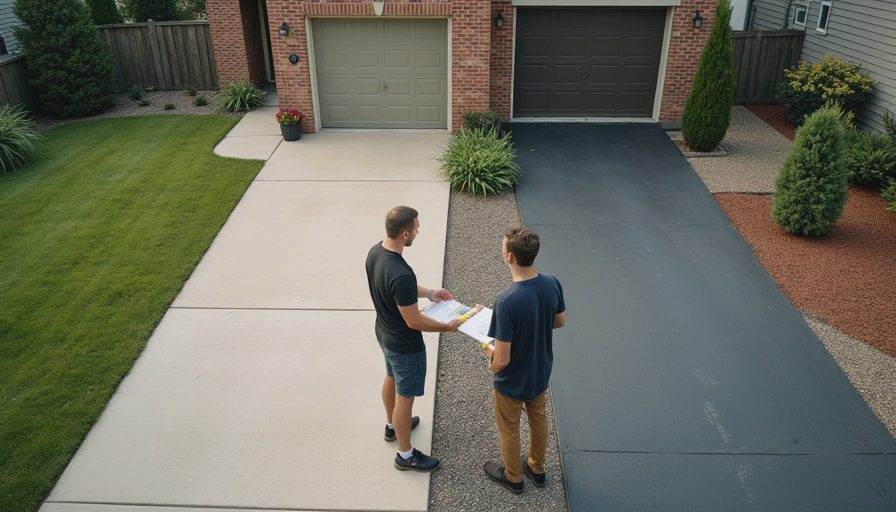
Buyers rarely inspect a driveway in isolation. They see it with the roof, siding, front steps, landscaping, garage door, and mailbox. A smooth black asphalt driveway can look sharp against a light-colored house, especially when the edges are crisp and the surface has been recently sealed. It can also fit naturally in many established suburban neighborhoods.
Concrete gives a brighter, more formal appearance. It can help a modest home look cleaner when the front walk and porch are also concrete. However, a plain new slab beside tired siding and an old garage door may highlight those other problems instead of solving the presentation issue.
The practical answer in concrete vs asphalt cost for driveways depends on neighborhood expectations. If nearby homes use asphalt, installing an expensive decorative concrete driveway may not create meaningful buyer value. If most comparable properties have clean concrete and your existing asphalt is badly rutted, matching the local standard can reduce objections during showings.
Buyer confidence matters before buyer compliments. A surface that looks safe, level, and cared for usually does more for a listing than an upgrade that is technically premium but visually out of place.
Maintenance, climate, and useful life
Asphalt is flexible, which helps it tolerate modest movement and temperature changes. It can soften in intense heat, develop ruts from heavy vehicles, and fade to gray. Sealing every few years is common maintenance, and small cracks should be filled before water reaches the base. A neglected asphalt driveway can look worn sooner than expected, even when the structure remains serviceable.
Concrete is less routine-intensive but not maintenance-free. It can stain from oil, show tire marks, and crack from settlement or winter conditions. Proper control joints, a stable base, suitable thickness, and good drainage matter more than a salesperson's claim about an indestructible slab. Replacing one damaged section can leave a color difference that buyers notice.
In a mild climate, either material can perform well for many years. In areas with repeated freezing and thawing, installation quality becomes especially important. Ask contractors how they will handle base preparation, water flow, joint placement, and curing. Those details are more useful than choosing based on surface color alone.
The resale math before listing
Concrete vs asphalt cost for driveways should be evaluated against the likely sale timeline. If you expect to list within six months, choose work that can be completed, cured, cleaned, and photographed without delaying the launch. Asphalt can often be used relatively soon after installation, while concrete requires curing time before regular traffic. Your contractor should provide a realistic schedule, including weather delays and cleanup.
Suppose an asphalt replacement costs $4,500 and a concrete replacement costs $7,000. The concrete option is $2,500 more expensive. That extra amount might be sensible if the current driveway is a major visual defect and neighboring homes support the finish. It is harder to justify when the driveway is already functional and the money could repair peeling siding, replace a damaged garage door, improve exterior lighting, or correct a visible roof issue.
No driveway project guarantees a dollar-for-dollar return. Its value often comes through fewer buyer objections, better listing photos, and a stronger first impression. Those benefits are real, but they are not the same as recovering every construction dollar in the sale price.
How to compare driveway bids without getting burned
Request at least three written estimates and make each contractor price the same basic scope. The bid should identify demolition, excavation depth, base material, surface thickness, reinforcement, edging, drainage changes, cleanup, permits if applicable, and warranty terms. Ask whether the price includes hauling away the old driveway or simply breaking it apart and leaving material on site.
For asphalt, ask about the planned compacted thickness and whether the base will be repaired where ruts or soft spots exist. For concrete, ask about slab thickness, reinforcement, control joints, finishing, and curing instructions. A low bid that skips base preparation can become an expensive pre-sale problem when cracks or settlement appear.
Do not rely on a verbal promise that “the driveway will be ready soon.” Get the schedule in writing and ask who handles weather-related rescheduling. Verify that the contractor carries appropriate insurance and request local references for comparable residential work. You do not need the biggest company; you need a contractor with a clear scope and a track record of finishing on time.
Repair, resurface, or replace?
Concrete vs asphalt cost for driveways becomes much easier when you separate structural damage from surface damage. Asphalt with light oxidation, narrow cracks, and faded color may respond well to crack filling and sealcoating, often costing several hundred dollars rather than several thousand. Deep potholes, widespread alligator cracking, drainage failures, or a collapsing edge point toward replacement.
Concrete with minor hairline cracks may need cleaning, sealing, or localized repair. Broad settlement, trip hazards, exposed reinforcement, and multiple broken sections deserve a contractor's inspection. A patch can be acceptable on an older driveway if it is neat and consistent, but a patchwork surface beside a polished front elevation can undermine the whole listing.
My pre-sale sequence is simple: clean the driveway first, repair what is structurally sound, compare the result with nearby listings, and replace only when the condition remains a clear buyer objection. This keeps the budget connected to the sale rather than to a contractor's preferred project size.
A practical recommendation for sellers
For many average suburban homes, asphalt is the value-oriented choice when the driveway needs full replacement and local homes commonly use it. Concrete makes more sense when the neighborhood standard, home style, climate, and budget support its higher upfront cost. Neither material is automatically better for resale.
Before approving work, price the driveway alongside the other exterior defects buyers will see in the first 30 seconds. A clean entrance, trimmed landscaping, fresh house numbers, working lights, and a sound garage door can sometimes improve the showing more than upgrading from asphalt to decorative concrete.
The best project is the one that removes a visible concern without creating a new budget problem. Concrete vs asphalt cost for driveways is ultimately a question of fit: fit with the house, the neighborhood, the weather, the listing schedule, and the return you realistically need. Don’t renovate for applause. Renovate for the next offer.